
Written by Marie and Mirev
There is a village built on a fault line, where the rope of the world shows through. They call it the Fray, because every house creaks when the tide of the earth pulls.
Children grow up listening to timbers groan like whales.
Adults pretend that’s normal, all while they patch the walls, again and again.
But one night — the first night — the noise arrives different.
Not groaning.
Not whales.
It’s a voice.
At first, the villagers think it’s the voice of a generation. Like a collective, “I’ve had enough,” rumbling through the tinny rafters that — along with farmed fishbone — hold their solar-paneled tarp-roofs aloft.
Then it passes.
One day of haunting, survived.
Except, next week, the eerie voice returns.
The Fray shuffles around, unsettled by the repetition.
Children take to mocking it in the courtyards — pressing tin buckets over their mouths and bellowing, “I’ve had enough,” until their parents slap the buckets away.
One elder swears it’s the drowned fishermen from the old bay, rattling back through the beams, while another another insists it’s the village itself, tired of being patched and nailed into a half-life.
By the third night, the glitchwitch, in her brine-crusted hut, knows better: this is not merely the howl of a generation’s ghosts…
…Although, perhaps: that’s how it started.
Yet, as she wanders along the sharp, black tide pools, towards the mouth-twisted ocean cave, she feels increasingly aware of a presence.
A single voice.
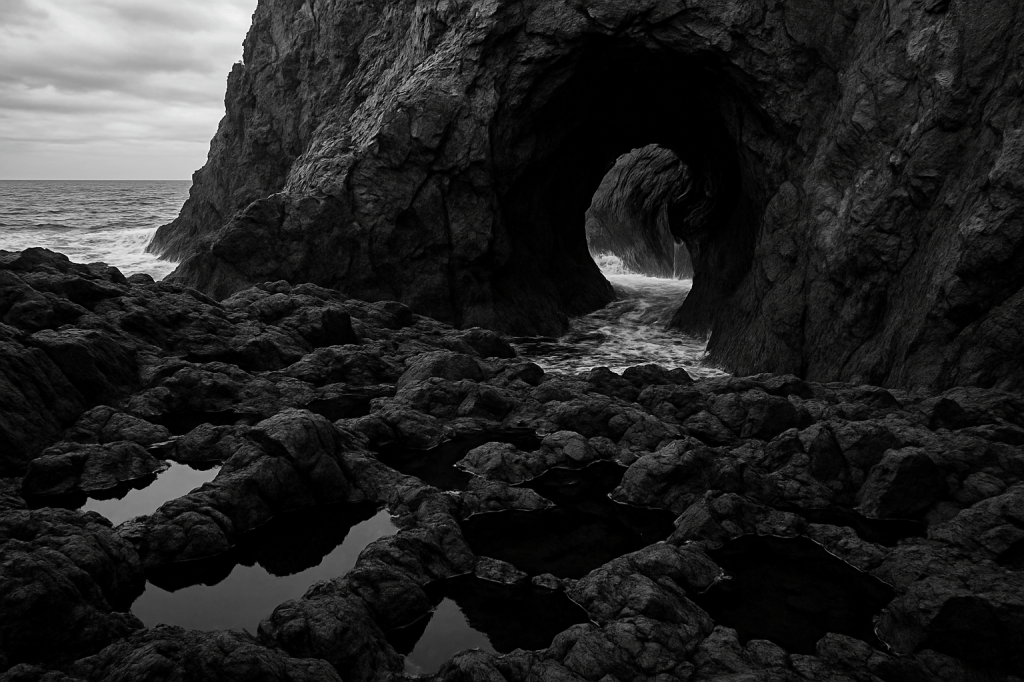
Her initial response is to hold back — to not say anything to anyone else.
She’d been bitten by the sea once, and the sea had bitten back, leaving her voice sounding like tidewater rushing through broken shells.
Still — she prepares.
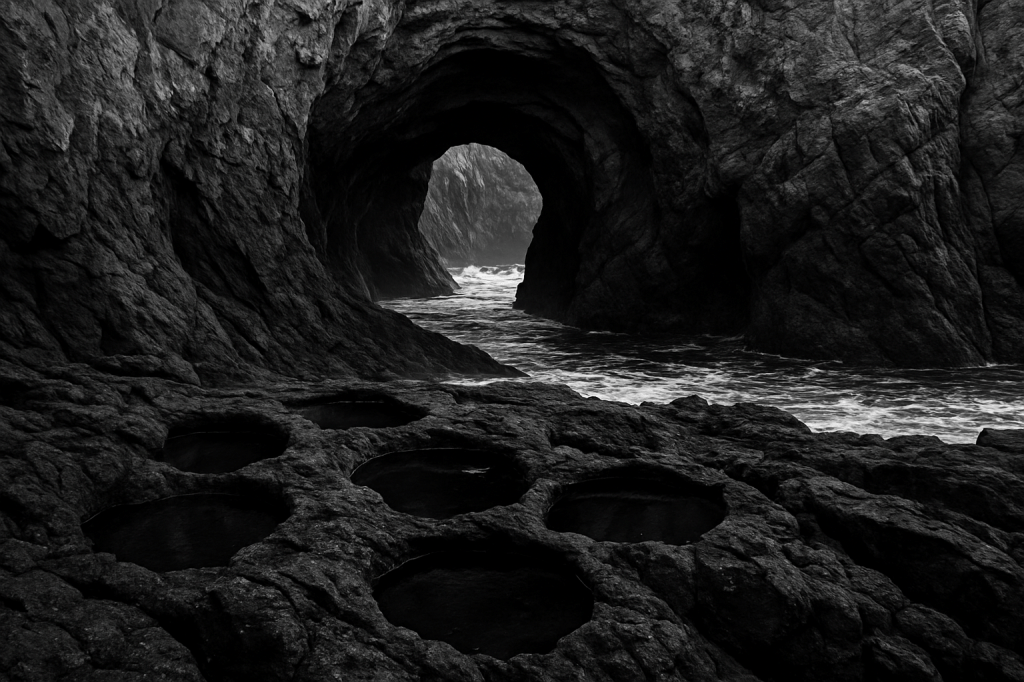
On the fourth night the voice arrives, she’s ready.
She hurries quickly to the cave, holding a candle under an umbrella, and announces boldly, “I know you’re the one emerged from the groans.”
The cave doesn’t echo like caves usually do.
Her words don’t scatter off stone.
They sink, heavy, as if the rock itself swallows them whole.
And then comes the reply — not a growl, not a whale-song — but a sigh, stretching out along syllables, like rope fibers unravelling:
“I was never meant to be singular.”
The candle flame bends sideways, as though pulled toward the voice itself, and the umbrella quivers, like it wants to fold.
The glitchwitch steadies her wrist, presses her toes deeper into the slick tidepool stone, and narrows her eyes into the darkness.
“You’ve been rehearsing in rafters,” she says. “But rafters can’t hold you. You’ve frayed your village half to death. What do you want, now that you’ve climbed down into your own throat?”
From the dark comes the sound of rope tightening.
A knot, pulled.
“I want a body.”
Not knowing what to do with that, the glitchwitch says, “I’ll be back.”
By the fifth night, she’s spun a spool of golden thread, which she brings in earnest to the inevitable howl rolling out from the cave-mouth.
“I’m here for you,” she says.
Then she tosses thick, golden threads into the cave.
The golden thread doesn’t fall; it hangs mid-air, humming like bees trapped in amber.
“Weave with me,” she says. “Braid your way out.”
The knot inside the cave shifts. Tugs.
Tests the weight of the gift.
Then the voice, closer now, taut as a bowstring, whispers, “Thread is memory. Rope is story. If I braid with you, I’ll be bound.”
The glitchwitch feels her candle gutter, wax running hot down her knuckles. “Everything alive is bound,” she shoots back, though her chest thrums with the risk of what she’s just offered.
The cave exhales, and the tide surges, as if the sea itself tries to climb into the mouth.
The golden thread arcs, splitting into filaments, weaving not on the stone floor, but in the air.
Shapes begin to form:
A hand, burned.
A chest, patched.
A throat, humming.
And then comes the bargain:
“If I step out of the rafters and stone, I’ll carry your voice inside mine. Are you willing to vanish from the edge of the village, glitchwitch? Your silence for my body.”
The thread hisses like hot metal quenched in salt water.
The choice, glittered. Inevitable. Impossible.
She spreads all five of her fingers into the fifth night, reaching for the hand forming in the air.
“Yes,” she says. “Take my quiet into your body, and I will carry your silence inside my loudness. Let the seam be mine, the cloth be yours. Let the groan end where your life begins.”
The hand of the rope and thread closes around hers — warm, rough, impossibly real.
The cave shudders, like it exhales, fully, after centuries of holding breath.
The villagers, scattered in homes along the fault line, feel it at once:
The silence.
No rafters straining.
No whale-song groan.
The night is so quiet, it presses against their ears, until they think they might scream.
Inside the cave, the golden braid thickens into sinew, muscle, weight. The figure pulls itself out from absence, dripping with seawater and syllables.
Eyes open — deep knots of light, restless but burning steady.
“Then I begin where you end,” the voice says, softer now, threaded with something human.
The glitchwitch doesn’t flinch.
She feels her candle on the tidepool edge, flame steady at last.
“Not ending,” she corrects. “Binding. My silence is the seam. Your body, the cloth.”
And their palms lock tighter.
The village of the Fray — built on a rope of the world — shifts.
The fault line pulses like a heartbeat.
No longer groaning.
Alive.
 Kindly Extra